
Translated from NepaliRead the original
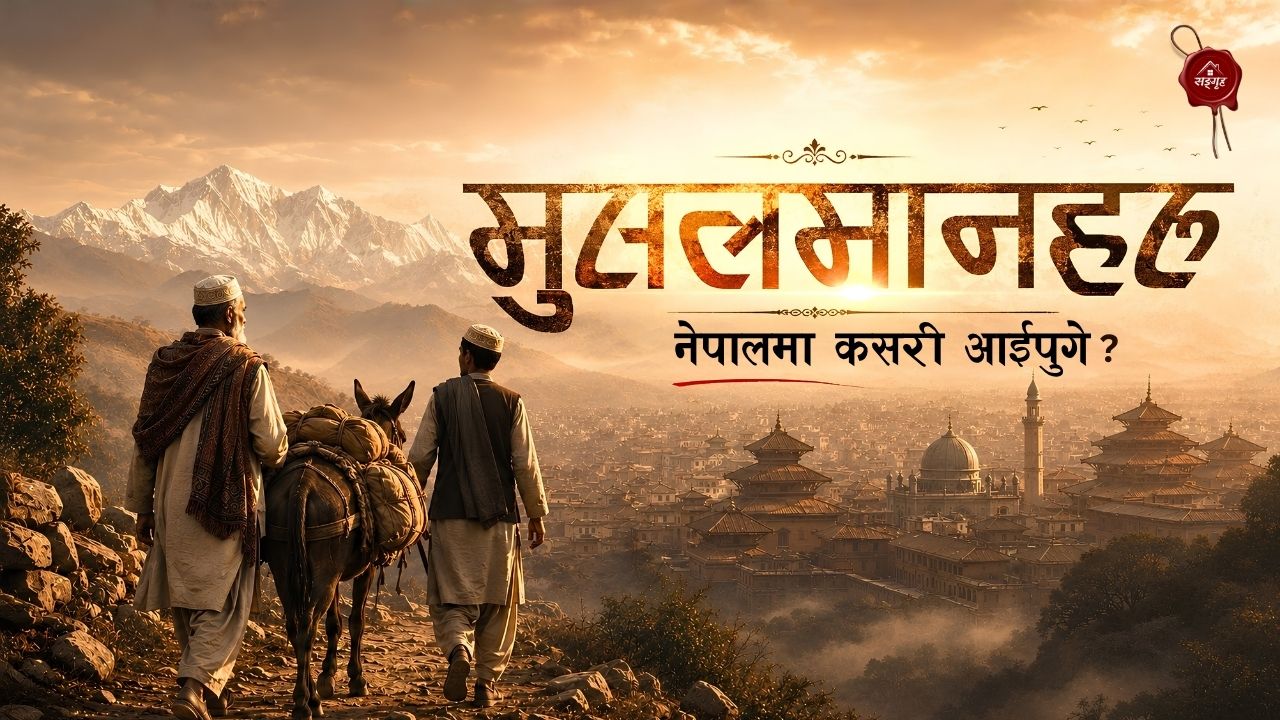
When we think of the religious images of Nepal, the bells of Hindu temples and the eyes of Buddhist stupas first come to our mind. But the voice of prayer has been resonating in the corner of this land for centuries. The Muslim community in Nepal today is the third largest religious group after Hindus and Buddhists, but their history is rarely discussed.
Muslims did not come to Nepal on a single day or because of a single event. Their relationship with Nepal has developed slowly. Initially, the trading people came to Nepal through the Himalayan trade routes. After that, the invasion of the Sultan of Bengal, the migration of traders from Kashmir, bangle sellers and skillful Kaligads, the refuge of the Begum of Awadh in Nepal, and later the great migration to the Terai region, the history of today’s Muslim community has been formed.
Arab Merchants, Silk Roads and Trade of Nepal
After the rise of Islam, Arab traders began to reach different parts of South Asia for trade. By the year 712 they had reached the Sindh region and Arab ships were also making regular visits to the west coast of India. But Nepal was not a land connected to the sea. Being a landlocked country surrounded by mountains, Arab ships were unlikely to come directly here.
However, Nepal was certainly an important trading center at that time. The Kathmandu Valley was considered a major stop on the Himalayan trade route from Patna in India and Bengal to Lhasa in Tibet. Salt, wool, gold and silver, musk, silk and other valuable goods were bought and sold through this route. Historians speculate that Muslim traders may have been involved in these business activities in one way or another.
But one thing needs to be clearly understood. There is no concrete historical evidence of permanent settlement of Muslim traders in the Kathmandu Valley in the early times. With trade, it is natural that new cultures, languages and ideas flow from one place to another. But there is not enough written evidence that the Muslim community settled here at that time. Therefore, it is appropriate to understand this phase of history more as a possibility and interpretation of historians than a proven fact.
First major invasion of Muslim power in Nepal (1349 AD)
The first major and clearly recorded event of Muslim power in Nepal’s history was not trade, but invasion. V.No. Around 1406 (AD 1349), Sultan Samsuddin Ilyas Shah of Bengal attacked Kathmandu Valley with his army. According to various genealogical and historical sources, his army damaged some religious places like Pashupatinath, Swayambhu, plundered the wealth and then returned to Bengal.
But there is one important aspect of this phenomenon that needs to be understood. After this attack, no Muslim rule was established in Nepal, nor did the Sultan’s army stay here. Rather than ruling Nepal, their aim was to loot and return. After the army returned, the Kathmandu Valley was again under the control of its own rulers.
The reason for mentioning this is also important. Sometimes one hears the idea that Islam spread in Nepal by the force of the sword. But the available historical evidence does not show so. This attack was only one incident in the initial conflict between Nepal and the Muslim powers. Today’s Nepali Muslim community did not originate from this attack.
However, historians still differ on when this attack took place, how much damage was done, and which locations were affected. Therefore, in understanding this event, it is necessary to take into account the available evidence and different historical interpretations.
Muslim traders from Mallakal and Kashmir
When we trace the history of the Muslim community that settled permanently in Nepal, we reach back to the Malla period. According to historians, it was during this time that the first verified Muslim community settled in Nepal. At that time, Kathmandu Valley was a prosperous center of trade, art and culture. Due to the trade routes connecting India and Tibet, traders from different countries and regions used to come here. At the same time, Muslim traders from Kashmir also started living in Kathmandu Valley.
These traders mainly traded in woolen shawls, cloth, silk and other valuable goods. They played an important role in connecting trade between India, Nepal and Tibet. As mentioned in history, during the reign of Raja Ratna Malla and later Raja Pratap Malla, they were allowed to settle in Kathmandu and build a mosque according to their religious beliefs and offer prayers.
Located near Ratnapark in Kathmandu Kashmiri Jame Masjid, which Kashmiri Takiya It is also said to be the oldest mosque in Nepal. According to most historians, it is believed to have been established during the reign of Pratap Malla. However, some studies suggest that its history may be even older.
Over time, these Kashmiri traders got mixed up with the society of Kathmandu. They were not just visitors who came to trade, but settled here permanently and developed their own community. Many families of the old Muslim community living in Kathmandu today are believed to trace their roots to these Kashmiri traders.
However, one thing needs to be clearly understood. Although it is a proven fact that Muslim traders from Kashmir settled in Nepal during the Malla period, there is still no consensus among historians as to the exact year and during the reign of which king they first came here. Therefore, there are different historical interpretations on this matter.
History of Kaligarh, Artisan and Cigarette Community
The history of the Muslim community in Nepal is not only connected with traders. Craftsmen with various skills and Kaligad also came to Nepal with them. In history we find mention of Muslim Kaligads who were able to make bangles, dye cloth, metal work and later made guns and gunpowder. Their skills are believed to have contributed significantly to the society and trade of the time.
Mostly the Muslim community living in the hilly areas of Nepal cigarettes known as This name is associated with their traditional profession. It is believed that they are called Churaute because they go from village to village to sell bangles. According to historians, this community is the descendants of people who came to Nepal from different parts of India from the late Malla period to the beginning of the Shah period.
Over time, these communities merged with the hill society. They adopted the Nepali language, assimilated themselves with the local culture and created their own distinct identity. Therefore, the language, culture and lifestyle of hill Muslim community is somewhat different from that of Terai Muslim community.
French historian Mark GaborioHe has made a detailed study of the history, lifestyle and social identity of the Churaute community. His research is still used as an important reference to understand the history of the Nepali Muslim community.
Shahkal and Prithvi Narayan Shah: What does history say?
One of the most discussed topics in Nepali Muslim history is related to the role of Prithvi Narayan Shah. There are different opinions on this matter, but not everything is proven history.
At the time of unification of Nepal, the Gorkha kingdom needed modern weapons, guns and ammunition. Hence, there has been a saying for a long time that Prithvi Narayan Shah brought the Muslim Kaligads to Nepal who were skilled in making guns and casting cannons. Oral histories of some communities and some writers have also mentioned this.
But there is one important thing to understand about this matter. Strong primary historical evidence that Prithvi Narayan Shah specifically called such Muslim Kaligads or mentioned them by name has not yet been found sufficiently. Therefore, it is better to see it as a possible interpretation of historians rather than a proven fact.
On the other hand, that of Prithvi Narayan Shah Divine SermonIt also clarifies his political thinking. He Nepal “Real Hindustan” He said and emphasized on the need to protect the country from excessive influence of foreign powers and foreign traders. He seems to be especially aware of the possibility that Mughal and European traders could influence the politics and business of Nepal.
This does not mean that he was against all Muslims. A possible picture of history is that he was ready to use the skills of a skilled man, but was equally cautious that no foreign power should become influential against the interests of Nepal.
So one thing can be said clearly. The settlement of the Muslim community in Nepal had already started long before the birth of Prithvi Narayan Shah. therefore “They brought Muslims into Nepal” That claim is inconsistent with history. Likewise “He was a staunch anti-Muslim.” or “Expel all Muslims from Nepal” The evidence does not support the claim. Given the limited evidence available on this topic, caution is warranted in drawing conclusions.
Ranakal, Terai migration and Begum Hazrat Mahal
The Rana period (1903-2007 / 1846-1951) is another important phase in the history of the Muslim community in Nepal. At this time, the relationship between Nepal and British India was very close, the effect of which was also seen in the population of Nepal.
The Rana rulers encouraged settlement in the Terai region with the aim of expanding farming and increasing revenue. After that, a large number of people from the border areas of Awadh, Bihar and Uttar Pradesh came and settled in the Terai of Nepal. Today, the largest Muslim community in Nepal, viz Terai or Madhesi Muslims, is believed to be associated with this migration. The influence of North India in their language, culture and traditions is evident even today.
Another important event of the Rana period is connected with the Indian rebellion of 1857. Queen of Awadh after the rebellion failed Begum Hazrat Mahal She came to Nepal and took refuge in Kathmandu. V.No. After his death in 1935 (1879), his mausoleum was built in the Jame Masjid complex near Ghantaghar in Kathmandu, which remains an important historical monument even today.
Thus the Rana period brought two major changes in the Muslim history of Nepal. First, a large number of Muslim communities settled permanently in the Terai region. Second, historical figures like Begum Hazrat Mahal, who were associated with the Indian independence movement, found refuge in Nepal. Both these events have given a new direction to the history of the Muslim community in Nepal.
Muslim community of modern Nepal
In today’s Nepal, Muslims are the third largest religious community after Hindus and Buddhists. V.No. According to the national census of 2068 (year 2011), they were about 4.4 percent of the total population. V.No. In the 2078 (year 2021) census, this number seems to have reached almost 5 percent. This indicates that both the presence and diversity of the Muslim community in Nepal is increasing.
But Nepali Muslims are not only one community. Based on their history, language and culture, they can be broadly divided into three groups.
first, Kashmiri Muslims of Kathmandu, whose ancestors came to Nepal for trade during the Malla period. secondly, Terai or Madhesi Muslims, who today constitute the largest Muslim community in Nepal and live mainly in the Terai districts. third, Pahari or Chiraute Muslims, who have mingled with the hill society for many generations and use Nepali as their main language.
The Muslim community mainly resides in Terai districts such as Kapilvastu, Banke, Rautahat, Bara, Parsa, Sunsari etc. Religiously, most of them belong to the Sunni sect, while some belong to the Shia community. Diversity is also found in language and culture. Some speak Urdu, some Awadhi, some Maithili, some use Nepali as their mother tongue.
Politically, too, great changes have taken place in recent decades. Nepal remained as a Hindu state for a long time. But V.No. The process started after the political change of 2063. Through the constitution of 2072 (year 2015), Nepal was declared a secular nation. Along with this, new debates and opportunities began to open up regarding the rights, representation, education and identity of other minority communities including the Muslim community.
Why is it important to distinguish fact, explanation and myth when understanding history?
The history of Muslims in Nepal is very long and varied. But in understanding this history, it is equally important to distinguish between proven facts, interpretations of historians and popular myths.
Proven historical facts include the invasion of Sultan Samsuddin Ilyas Shah of Bengal in 1349, the settlement of Kashmiri Muslim traders during the Malla period, the historical significance of the Kashmiri Jame Masjid in Kathmandu, the Muslim migration to the Terai region during the Rana period, Begum Hazrat Mahal’s refuge in Nepal and national census data.
Apart from this, there are some issues where there is still no consensus among historians. For example, there are differing views on whether Muslim gunsmiths or Kaligad were specifically brought to Nepal by Prithvi Narayan Shah, when the Kashmiri Jame Masjid was actually established, or how deep the Muslim community’s ties to Nepal were through the early Silk Route. As the available evidence is limited, no definite conclusions can be drawn on such matters.
Similarly, there are some popular beliefs that don’t match history. Islam spread in Nepal mainly through invasion, All the Muslims of Nepal were brought in by Prithvi Narayan Shah, or Nepali Muslims are all recent immigrants from India These claims are not supported by the available historical evidence.
Therefore, the best way to understand the history of Nepal’s Muslim community is to base it on facts rather than emotion, evidence rather than rumours, and history rather than myth. Only by doing so can we understand the common history of all communities in Nepal fairly and respectfully.
conclusion
The history of Muslims in Nepal is not a story connected only to a single event, war or ruler. It is a long journey built up slowly by trade, migration, skills, asylum and social changes that took place at different times. From the traders of Kashmir to the cigarette communities of the hills, from the Madhesi Muslims of the Terai to the old Muslim settlements of Kathmandu, this history has become an integral part of the social and cultural journey of Nepal.
History shows that the Muslims of Nepal have been living, working and building their own identity with this society for centuries.
The most correct way to understand history is to accept evidence-based facts, to be open-minded about controversial issues, and to prefer real history to myth. Only by doing so can we fairly understand the shared history of all communities in Nepal and show due respect to it.❤️
Transparency
How this story was made · Feature
- Sources cited
- Fact-checked
- Editorial review
- Verified writer
- Published
- Jul 31, 2026
- Updated
- Oct 31, 2026
- Editorial review
- Bikal