

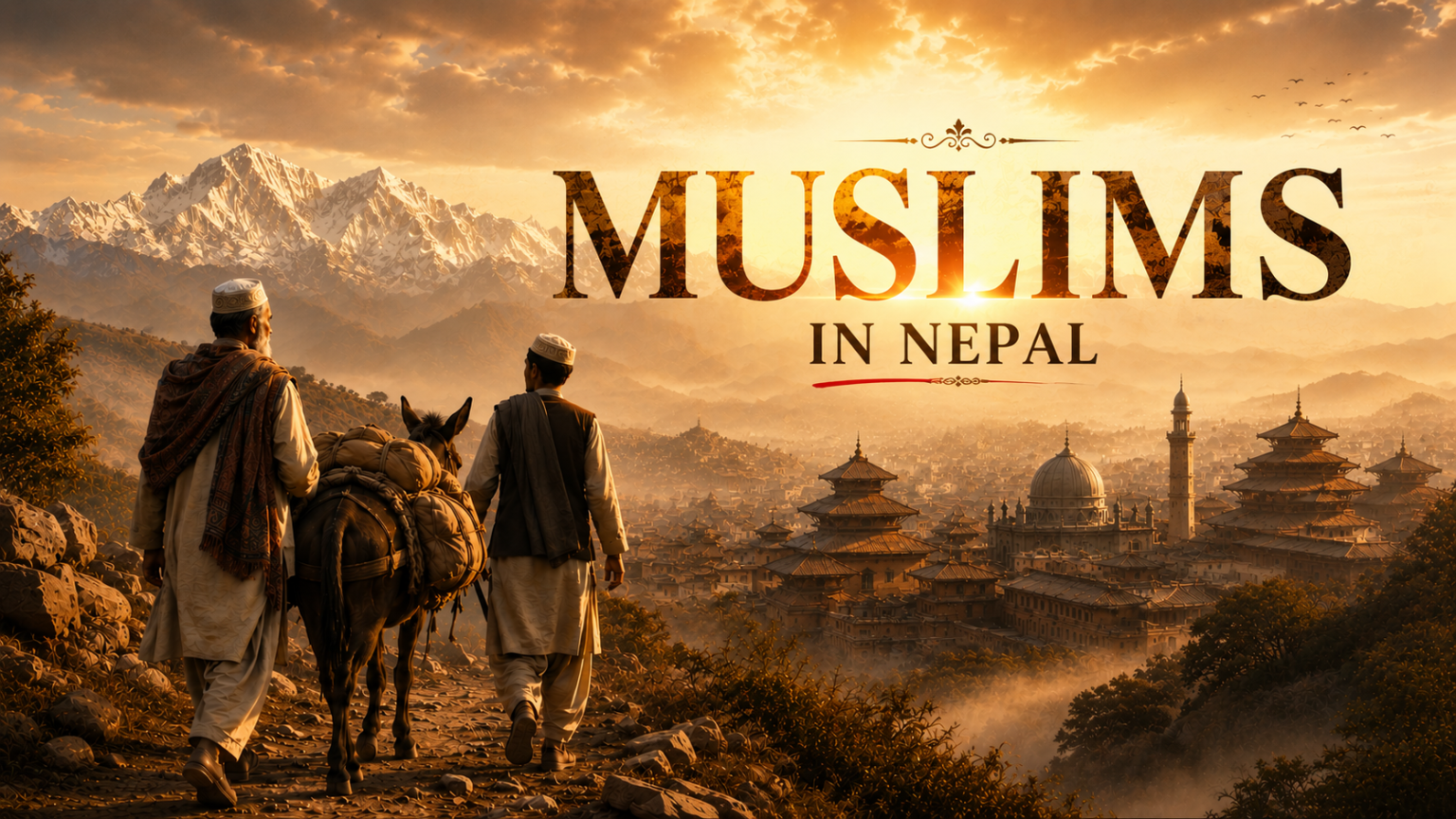
When we picture Nepal’s religious landscape, our minds turn first to the bells of Hindu temples and the watchful eyes of Buddhist stupas. Yet in the quiet corners of this same land, the call to prayer has echoed for centuries as well. Today, Muslims are Nepal’s third-largest religious community after Hindus and Buddhists, and yet their history is rarely told.
Muslims did not arrive in Nepal on a single day or through a single event. Their connection with this land developed slowly, over a long span of time. First came traders, travelling the trans-Himalayan trade routes until they reached Nepal. Then came the raid of a Bengali sultan, merchants from Kashmir, the settlement of bangle-sellers and skilled artisans, the refuge granted to a queen from Awadh, and later the large-scale migration into the Terai plains. Piece by piece, over centuries, the history of today’s Muslim community was built.
Arab Traders, the Silk Road, and Nepal’s Commerce
After the rise of Islam, Arab merchants began reaching various parts of South Asia for trade. By around 712 CE they had arrived in the Sindh region, and Arab ships were sailing regularly along the western coast of India. But Nepal was not a land connected to the sea. Ringed by the Himalaya and landlocked, it was never a place where Arab ships could dock directly.
Nepal was, however, an important commercial hub of its time. The Kathmandu Valley was regarded as a key resting point on the trans-Himalayan trade route that ran from Patna and Bengal in India up to Lhasa in Tibet. Along this route moved salt, wool, gold and silver, musk, silk, and other valuable goods. Historians believe Muslim traders were involved, in one form or another, in this flow of commerce.

One point deserves clarity, though. There is, as yet, no firm historical evidence that Muslim traders settled permanently inside the Kathmandu Valley in this early period. It is natural for new cultures, languages, and ideas to travel from one place to another alongside trade. But written evidence of a Muslim community actually residing here at that time is not sufficient. This chapter of history, therefore, is better understood as possibility and scholarly interpretation rather than as proven fact.
The First Major Muslim Attack on Nepal (1349 CE)
The first large and clearly recorded encounter between a Muslim power and Nepal was not commerce but a raid. Around 1349 CE (BS 1406), Sultan Shamsuddin Ilyas Shah of Bengal marched on the Kathmandu Valley with his army. According to various chronicles and historical sources, his forces damaged several religious sites including Pashupatinath and Swayambhunath, looted wealth, and then withdrew towards Bengal.
An important aspect of this event must be understood. No Muslim rule was established in Nepal after this raid, nor did the sultan’s soldiers remain. Their aim was not to govern Nepal but to plunder and return. Once the army withdrew, the Kathmandu Valley returned to the control of its own rulers.
The reason for stressing this is significant. One sometimes hears the notion that Islam spread in Nepal by the force of the sword. The available historical evidence does not support that. This raid was merely one episode among the early clashes between Nepal and a Muslim power. The origins of today’s Nepali Muslim community do not lie in this attack.
That said, historians still differ on exactly when the raid took place, how much damage it caused, and which sites were affected. Understanding this event therefore requires weighing the available evidence alongside these differing historical interpretations.
The Malla Period and Muslim Traders from Kashmir
When we search for the history of a Muslim community that settled permanently in Nepal, we arrive at the Malla period. According to historians, the first documented Muslim community to reside in Nepal appears at this time. The Kathmandu Valley was then a rich centre of trade, art, and culture. Because of the trade route linking India and Tibet, merchants from many countries and regions came here. It was in this context that Muslim traders from Kashmir began to settle in the valley.
These merchants dealt chiefly in woollen shawls, cloth, silk, and other precious goods. They played an important role in linking the commerce of India, Nepal, and Tibet. As recorded in history, during the reigns of King Ratna Malla and later King Pratap Malla, they were granted permission to settle in Kathmandu and to build a mosque where they could worship according to their faith.
The Kashmiri Jame Masjid near Ratna Park in Kathmandu, also known as the Kashmiri Takiya, is considered the oldest mosque in Nepal. Most historians hold that it was founded during the reign of Pratap Malla, though some studies suggest its history may be even older.
Over time, these Kashmiri traders blended into Kathmandu’s society. They did not remain mere visiting guests who had come only to trade; they settled here permanently and grew into a community of their own. Many old Muslim families of Kathmandu today are believed to trace their roots back to these Kashmiri merchants.
Yet one point should be understood clearly. While the fact of Kashmiri Muslim traders settling in Nepal during the Malla period is well established, historians have not reached full agreement on exactly which year and under which king they first arrived. Differing historical interpretations exist on this question.
Artisans, Craftsmen, and the History of the Churaute Community
The history of Nepal’s Muslim community is not tied to traders alone. Skilled artisans and craftsmen came to Nepal alongside them. History records Muslim craftsmen who made bangles, dyed cloth, worked metal, and later manufactured guns and gunpowder. Their skills are believed to have made an important contribution to the society and commerce of the time.
The Muslim community that settled in Nepal’s hill regions is often known as Churaute. The name is linked to their traditional occupation. Because they travelled from village to village selling bangles (churā), they came to be called Churaute. According to historians, this community descends from people who came to Nepal from various parts of India between the late Malla period and the early Shah period.
Over time these communities blended into hill society. They adopted the Nepali language, adapted to the local culture, and shaped a distinct identity of their own. For this reason the language, culture, and way of life of the hill Muslim community differ somewhat from those of the Muslim community in the Terai.
The French historian Marc Gaborieau carried out detailed studies of the Churaute community’s history, way of life, and social identity. His research is still used today as an important reference for understanding the history of Nepal’s Muslims.
The Shah Period and Prithvi Narayan Shah: What Does History Say?
One of the most discussed subjects in Nepali Muslim history concerns the role of Prithvi Narayan Shah. Various beliefs surround this question, but not all of them are proven history.
During the unification of Nepal, the Gorkha state needed modern weapons, guns, and gunpowder. For a long time, therefore, a claim has circulated that Prithvi Narayan Shah brought Muslim craftsmen skilled in making guns and casting cannon to Nepal. Some communities’ oral histories, and some writers too, have repeated this.
But an important caveat must be understood here. Strong primary historical evidence that Prithvi Narayan Shah specifically summoned such Muslim craftsmen, or that named them, has not yet been found in sufficient measure. It is therefore more appropriate to treat this as one possible interpretation by historians rather than as proven fact.
On the other hand, Prithvi Narayan Shah’s Dibya Upadesh clarifies his political thinking. He called Nepal “asali Hindustan” (a true Hindustan) and stressed the need to protect the country from the excessive influence of foreign powers and outside traders. He appears particularly alert to the possibility that Mughal and European merchants might come to dominate Nepal’s politics and trade.
This does not mean he was an opponent of all Muslims. The plausible picture history offers is that he was willing to make use of skilled people’s abilities, while remaining equally cautious that no foreign power should grow influential in ways contrary to Nepal’s interests.
One thing, therefore, can be stated clearly. The settlement of the Muslim community in Nepal had begun long before Prithvi Narayan Shah was born. The claim that “he brought the Muslims into Nepal” does not accord with history. Equally, the claims that “he was a fierce opponent of Muslims” or that “he expelled all Muslims from Nepal” are not supported by evidence either. Because the available evidence on this subject is limited, caution is the wisest course when drawing conclusions.
The Rana Era, Migration into the Terai, and Begum Hazrat Mahal
The Rana era (1846–1951 CE / BS 1903–2007) marks another important chapter in the history of Nepal’s Muslim community. During this period the ties between Nepal and British India were very close, and this had visible effects on Nepal’s population as well.
The Rana rulers encouraged settlement in the Terai in order to expand agriculture and increase revenue. Large numbers of people then migrated into Nepal’s Terai from the bordering regions of Awadh, Bihar, and Uttar Pradesh. Nepal’s largest Muslim community today, the Terai or Madhesi Muslims, is regarded as connected to this migration. The influence of north India is still clearly visible in their language, culture, and traditions.
Another significant event of the Rana era is linked to the Indian revolt of 1857. After the revolt failed, Begum Hazrat Mahal of Awadh came to Nepal and was granted refuge in Kathmandu. After her death in 1879 CE (BS 1935), her tomb was built within the Jame Masjid complex near Ghantaghar in Kathmandu, and it stands today as an important memorial of history.
In this way the Rana era brought two major changes to Nepal’s Muslim history. First, a large Muslim community settled permanently in the Terai. Second, historical figures connected to the Indian independence movement, such as Begum Hazrat Mahal, found refuge in Nepal. Both events gave a new direction to the history of Nepal’s Muslim community.
Muslim Communities in Modern Nepal
In Nepal today, Muslims form the third-largest religious community after Hindus and Buddhists. According to the national census of 2011 CE (BS 2068), they made up about 4.4 percent of the total population. In the 2021 CE (BS 2078) census this figure appears to have risen to nearly 5 percent. This points to a growing presence and diversity of the Muslim community in Nepal.
But Nepali Muslims are not a single, uniform community. On the basis of their history, language, and culture, they can be understood mainly in three groups.
First are the Kashmiri Muslims of Kathmandu, whose ancestors came to Nepal for trade during the Malla period. Second are the Terai or Madhesi Muslims, who today form Nepal’s largest Muslim community and live mainly in the Terai districts. Third are the hill or Churaute Muslims, who have blended into hill society over many generations and use Nepali as their primary language.
The Muslim community lives especially in Terai districts such as Kapilvastu, Banke, Rautahat, Bara, Parsa, and Sunsari. In religious terms, most belong to the Sunni sect, while some belong to the Shia community. There is diversity in language and culture too. Some speak Urdu, some Awadhi, some Maithili, and some use Nepali as their mother tongue.
Politically, too, recent decades have brought great change. Nepal remained a Hindu state for a long time. But the process that began after the political change of BS 2063 led, through the constitution of 2015 CE (BS 2072), to Nepal being declared a secular state. Along with this, new debates and opportunities began to open around the rights, representation, education, and identity of the Muslim community and other minority communities.
Why It Matters to Separate Fact, Interpretation, and Myth
The history of Nepal’s Muslims is long and diverse. But in understanding this history, it is equally necessary to distinguish proven fact, historians’ interpretation, and the myths that circulate among the public.
The proven historical facts include the 1349 raid by Sultan Shamsuddin Ilyas Shah of Bengal, the settlement of Kashmiri Muslim traders during the Malla period, the historical significance of Kathmandu’s Kashmiri Jame Masjid, the Muslim migration into the Terai during the Rana era, the refuge granted to Begum Hazrat Mahal in Nepal, and the figures of the national census.
Beyond these are subjects on which historians have not yet reached agreement. For instance, whether Prithvi Narayan Shah specifically brought Muslim gunsmiths or craftsmen to Nepal, when the Kashmiri Jame Masjid was actually founded, and how deep a connection the Muslim community had with Nepal through the early Silk Road, all invite differing views. Because the available evidence is limited, no definite conclusion can be drawn on such questions.
Likewise, there are popular notions that do not accord with history. The claims that Islam spread in Nepal chiefly through invasion, that Prithvi Narayan Shah himself brought in all of Nepal’s Muslims, or that all Nepali Muslims are recent foreigners from India, are not supported by the available historical evidence.
The best way to understand the history of Nepal’s Muslim community, therefore, is to ground it in fact rather than emotion, in evidence rather than rumour, and in history rather than myth. Only then can we understand the shared history of all of Nepal’s communities fairly and with respect.
Conclusion
The history of Muslims in Nepal is not a story tied to a single event, war, or ruler. It is a long journey, built gradually through trade, migration, skill, refuge, and the social changes of different eras. From the traders of Kashmir to the Churaute community of the hills, from the Madhesi Muslims of the Terai to the old Muslim quarters of Kathmandu, this history has become an inseparable part of Nepal’s own social and cultural journey.
History shows that Nepal’s Muslims have lived alongside this society for centuries, worked within it, and built their own identity over time.
The truest path to understanding history is to accept fact grounded in evidence, to approach contested subjects with an open mind, and to give precedence to real history over myth. Only if we do so can we understand the shared history of all of Nepal’s communities fairly, and express fitting respect towards it.❤️