

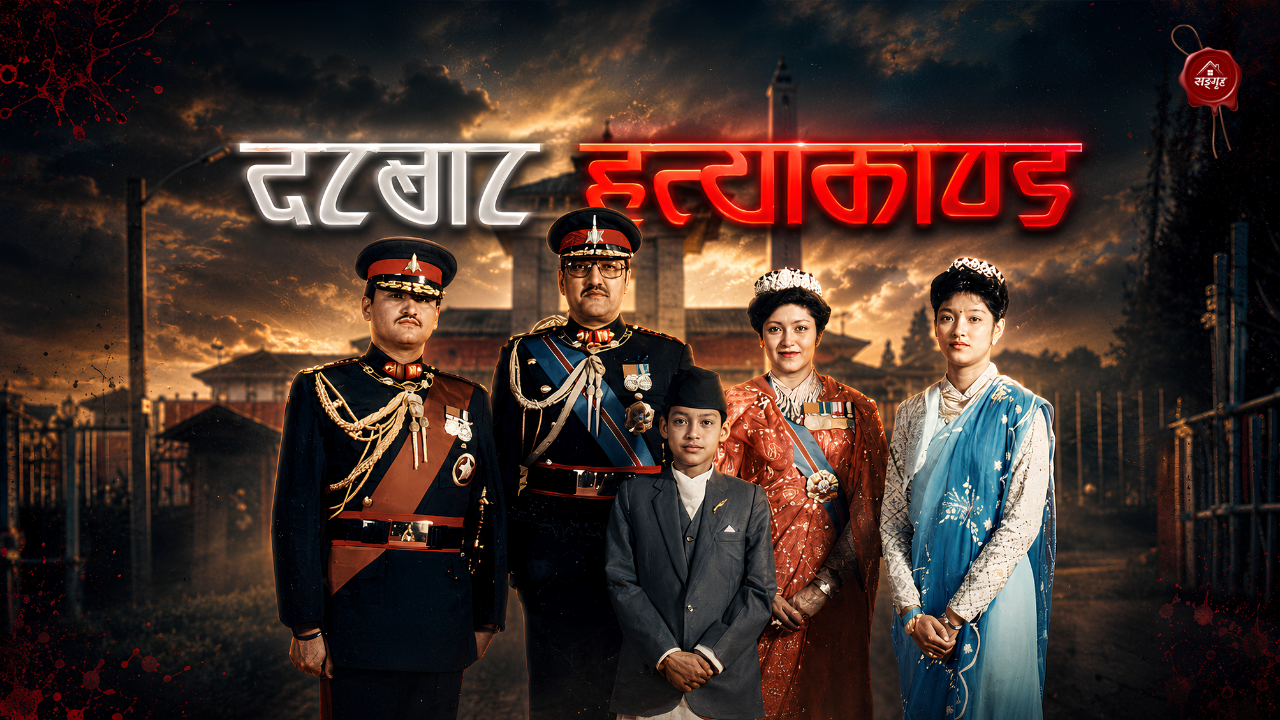
There is a story we have all heard. On the night of Friday, June 1, 2001 (19 Jeth 2058), inside the Narayanhiti Royal Palace, Crown Prince Dipendra, drunk and enraged over a marriage dispute, gunned down his own parents, siblings, and relatives, and then shot himself. The official commission of inquiry said exactly this. The world believed it.
But there is another story too. And it does not live in rumor. It lives inside that same official report. When you study the commission’s own documents, the commission’s own timings, the commission’s own facts, one uncomfortable question rises to the surface: the math does not add up. This is the story of that missing arithmetic in the Nepal royal massacre. And now, twenty-five years later, Nepal is talking about reopening the file.
First, the official story
According to the commission’s report, the family had gathered that night at Tribhuvan Sadan for its monthly get-together, held on the third Friday of every Nepali month. King Birendra, Queen Aishwarya, Queen Mother Ratna, Crown Prince Dipendra, Prince Nirajan, Princess Shruti, Dhirendra Shah, Gyanendra’s wife Komal, his son Paras, and Paras’s wife Himani were among roughly two dozen guests. One man was absent: Prince Gyanendra, who was in Pokhara that day for a program of the Mahendra Trust for Nature Conservation, which he chaired.
Dipendra arrived early and began drinking Famous Grouse whisky. The report states that around 8:15 PM he made a call from his mobile and asked an aide to prepare a special cigarette laced with cannabis and another unidentified black substance. Soon he began to falter. Nirajan, Paras, Kumar Gorakh, and Dr. Rajiv Shahi carried him to his room.

Then, the report says, Dipendra returned in military fatigues, armed, and opened fire. That is the official story. Dipendra, the sole culprit.
From here, the questions raised by the report’s own facts begin.
Hole one: the commission’s clock
The report fixes the exact time each victim was declared dead at Birendra Army Hospital in Chhauni. Look at those times:
- King Birendra: declared dead at 9:15 PM.
- Queen Aishwarya: declared dead at 9:15 PM.
- Prince Nirajan: declared dead at 9:15 PM.
- Shruti: brought in at 9:20 PM, declared dead at 9:55 PM.
- Shanti: 9:35 PM.
- Sharada and Jayanti: 9:30 PM.
- Kumar Khadgavikram: 9:35 PM.
Now place those times against the sequence of events. The report says Dipendra staggered to his room around 8:15 PM. He then returned, put on combat dress, took up weapons, walked into the sitting room, and began firing. By most accounts, all of this pushed the shooting to roughly 9:00 PM.
So here is the question at the heart of the Nepal royal massacre: within minutes of the first shots, how were King Birendra, Queen Aishwarya, and Nirajan pulled out of Narayanhiti, loaded into vehicles, driven to Chhauni, examined by doctors, and all three declared dead at exactly 9:15 PM?
A second question deepens it. Why were the wounded taken to the relatively distant Birendra Army Hospital in Chhauni rather than the much nearer Bir Hospital or Teaching Hospital? In the chaos of that night, simply gathering gravely wounded bodies, finding vehicles, and crossing the city to a farther hospital takes time. Yet by the report’s own clock, only about fifteen minutes separate the first shots from three death declarations. The window is so tight that many ask: was this truly possible so fast, or was the timeline itself adjusted somewhere?
This is not a tale of some foreign conspiracy. It is a question raised by the commission’s own clock. And a satisfying answer has never been found.
Hole two: evidence collected eight days later
In any serious crime, the scene is a goldmine. Bullets, casings, blood, weapons, every item tells a story. But that story can only be trusted if the evidence is collected while it is fresh and the scene is untouched.
Here the report reveals another uncomfortable fact. The date recorded for the collection of physical evidence from the scene is 27 and 28 Jeth 2058, that is, June 9 and 10, 2001. But the massacre happened on 19 Jeth, June 1. In other words, much of the physical evidence was collected only some eight to nine days after the event.
What state was the scene in for those eight days? Who entered it? What was moved, cleaned, or removed? How reliably can a bullet or casing collected eight days later speak to the truth of that night? The basic rules of criminal investigation treat such a delay as a serious weakness. The later the evidence is gathered, the less it can be trusted.
Hole three: weapons handled with bare hands
Photographs from this massacre have circulated for years. Some of them stun forensic experts, because they appear to show weapons and objects from the scene being handled with bare hands.
In criminal investigation, this is among the gravest errors. A gun, a bullet, the fingerprints and trace evidence on them can reveal who touched what. But when the very people involved in the investigation handled those weapons barehanded, that original evidence was damaged or erased forever. Whose fingerprints were on them can now never be established with certainty.
The question is unavoidable: how did such a basic error occur in the investigation of the country’s largest massacre? Was it mere inexperience, or negligence that blurred the truth?
Hole four: no autopsy, a demolished scene
The backbone of modern crime investigation is the autopsy. The angle a bullet entered, the distance, the direction, only a post-mortem can establish these scientifically. Yet in a massacre of this scale, it is alleged that the bodies were cremated quickly without a proper, independent autopsy.
No autopsy means the single most important scientific evidence of that night was destroyed forever. Beyond that, no formal police complaint (FIR) was even registered. With neither an FIR nor a post-mortem, Nepal Police never formally entered the country’s biggest murder case at all.
And one more fact compounds it. Tribhuvan Sadan, the building where this happened, was demolished roughly fourteen years later. Once the scene itself was gone, so was any chance that future technology might re-examine it. Evidence was collected late, weapons were touched barehanded, no autopsy was done, and finally the scene itself was torn down. One after another, why did every physical basis for finding the truth vanish?
Hole five: the left-hand mystery
Dipendra is said to have been right-handed. Yet the fatal shot to his head is reported to have entered from the left side. When a person shoots himself, he typically uses his dominant hand, the right.
An intriguing detail appears in Paras Shah’s own testimony. According to him, Dipendra carried four weapons that night, and the hand gun (a Glock pistol) was on his left side. But how the fatal shot came from the left has never been clearly explained. If it was difficult for Dipendra to shoot himself from the left side, then who fired that shot? The question has gone unanswered for twenty-five years.
Hole six: one man, that arsenal?
The list of weapons in the report reads like the armory of a small army. The items collected from the scene include:
- An M16 A2 rifle (Commando), with two magazines.
- An HK MP-5K 9mm submachine gun, with three magazines (one with 28 rounds, one with 27, one empty).
- A 9mm Glock pistol with holster and a loaded magazine.
- A 12-bore SPAS-12 FRANCHI-BRESCIA shotgun.
That is not all. Dozens of shell casings were found across the scene: 39 inside the billiard room, 18 out in the courtyard, 7 at the gate of a building under construction, and more at the billiard room’s east door.
By Paras’s own account, Dipendra moved in and out, in and out, with gaps of at most thirty seconds. So the question arises: a man staggering under the influence of alcohol and an unknown substance, who minutes earlier had to be carried to his room and reportedly could not even undress, then somehow fitted into military combat dress in minutes, carried this many different weapons, reloaded repeatedly, and fired accurately across so many locations from the room to the garden, was that even physically possible? The debate continues to this day.
Hole seven: who wasn’t there, who survived
That night, King Birendra’s immediate family was almost entirely wiped out. Yet a few facts still unsettle the public.
That night Gyanendra was not in Kathmandu; he was in Pokhara. Later, he became king. His son Paras was present and survived. In his testimony, Paras described shielding his sisters, his wife, and others behind sofas and corners, and personally helping carry the wounded to the hospital.
Another detail deepens the mystery. Prekshya, the wife of Dhirendra, who was absent from the gathering that night, died about five months later in an accident at Rara Lake. Whether that was coincidence is another question lodged in the public mind.
All of this prompted the question: those in the line of succession all died; those who survived, their family came to power. Was it all coincidence?
Here, clarity is essential. These are public suspicions, not proven accusations. Former King Gyanendra has repeatedly denied such allegations against his family, and no concrete, public evidence has ever surfaced that any survivor was involved in the massacre. But these questions arose precisely because of the holes in the official story above. When the official account is itself full of gaps, people begin asking alternative questions.
Fingers pointed in politics
This suspicion did not stay confined to the public. Major political leaders pointed fingers from public platforms too.
Girija Prasad Koirala, who was prime minister at the time of the massacre, called the event a “grand design.” Maoist Centre chairman Pushpa Kamal Dahal “Prachanda” on various occasions presented Gyanendra as the planner of the massacre, citing the fact that Gyanendra’s family suffered no loss and that he was away from Kathmandu that day.
Prime Minister KP Sharma Oli raised it as well. Speaking at a program in Kathmandu on March 20, 2025 (Chaitra 7, 2081), Oli alleged that King Birendra’s family was killed to seize power. Pointing toward the media, he said that after power was seized, the work of “raising a gun behind the news anchor” took place. He added that the Nepali people are now alert enough that no upheaval against democracy is possible.
But honesty is required here. Although these leaders made grave allegations publicly, no one has ever released evidence at the level needed to prove Gyanendra or anyone else guilty. These are political statements, not judicial findings.
The foreign conspiracy and the “new Kot Massacre”
Some commentators view the Nepal royal massacre in a far wider frame than a domestic family dispute. Its most famous expression was an article by Maoist leader Dr. Baburam Bhattarai, “Let us not legitimize a new Kot Massacre,” published in the Kantipur daily soon after the killings. For publishing it, Kantipur’s editors and publisher were arrested.
Bhattarai’s argument was that the “love affair” and “accident” narratives were being promoted to mask a deeper political conspiracy. He asked how an automatic weapon could, on its own, enter a highly secure room, selectively kill every member of one family, and leave another family untouched. Linking King Birendra’s independent foreign policy, his reluctance to deploy the army against the Maoists, and his soft ties with China, Bhattarai cast the event as a “grand design” of “expansionist and imperialist” forces.
Yet the same honesty applies here. No concrete, public evidence has ever confirmed this foreign-conspiracy theory. It rests on circumstantial inference and political interpretation. So it is best treated not as proven truth, but as a serious question that keeps being asked.
Questions about the investigation itself
The root of all these questions converges on one place: the investigation process itself. The commission, led by Chief Justice Keshav Prasad Upadhyaya and Speaker Taranath Ranabhat, produced its report within about a week. Initially, opposition leader Madhav Kumar Nepal was to be a member too, but after he resigned, following his party’s decision, only two people conducted the investigation.
Moreover, the inquiry into so complex an event was wrapped up very fast and rested mainly on eyewitness accounts rather than hard scientific evidence. Since Dipendra, named as the main accused, was already dead, there was no way to hear his side. One-sided testimony, late-collected evidence, weapons touched barehanded, and the absence of an autopsy, together they produced a report that delivered a conclusion but failed to deliver trust.
Ten unanswered questions
Even twenty-five years on, the main questions circling this massacre, gathered in one place, look like this:
- Was it mere coincidence that every member of Birendra’s family died that day?
- Dipendra had to be carried to his room when he could not stand, so how did he appear moments later carrying weapons?
- Unable even to take off his clothes shortly before, how did he fit into military combat dress within minutes?
- When and how was Prince Nirajan shot?
- How was Dipendra himself shot?
- Why were the wounded taken to distant Chhauni rather than the nearby Bir or Teaching hospitals?
- Was the death of Prekshya, absent that day, in a Rara Lake accident five months later, a coincidence?
- Declared king for three days, was Dipendra truly alive until June 4 (22 Jeth)?
- Why was no autopsy performed on the victims?
- Why was Tribhuvan Sadan, where it happened, demolished?
What these questions share is that no official body has answered them to this day.
The old file reopens
After the Gen Z movement of 2025 (2082) and the new political structure that followed, demands for transparency and accountability rose. In that context, a decision has been taken to reopen the file on the Nepal royal massacre, unfinished for twenty-five years.
Home Minister Sudhan Gurung, who had resigned after questions were raised about his property, returned to lead the Home Ministry a second time after about forty-eight days. Taking charge in June 2026 (Jeth 2083), one of the four main decisions he announced was to advance the investigation into the royal massacre. For a long stretch after the republic was established, the state had carried out no further inquiry into the case. Even Prime Minister Prachanda, after the republic in 2008, had spoken of an investigation, but it remained incomplete.
Whether this decision is mere “stunt” or genuine resolve remains to be seen. Security experts call such an investigation deeply challenging. According to former Deputy Inspector General Hemanta Malla, there is now no technical evidence such as forensic analysis or objective scene documentation, and putting ten witnesses on record today could produce ten different accounts. His warning: an unbiased investigation could leave a good mark on history, but an inquiry driven by bad intent would only spread confusion among the public.
Still, an investigation is not impossible. Under Section 187 of the Criminal Code 2074, where the accused is identified, investigation and prosecution can proceed at any time. Some grounds still remain: medical records from the treatment can be checked to see whether they survive, eyewitnesses including Devyani Rana can be re-examined, and the scene photographs and video shot at the time by then-police officer Sher Bahadur Karki can be re-analyzed with modern technology. Even though the scene is gone, these records may still have something to say.
Conclusion: not haste, but patience
The official report named Crown Prince Dipendra as the culprit of the massacre. That is the official conclusion, and it cannot be dismissed wholesale.
Yet as this article has shown, the holes inside that same report are also real. The timeline that does not add up, evidence collected eight days late, weapons touched barehanded, the missing autopsy, and the left-hand mystery, these are not works of fiction. They are real questions raised by the commission’s own documents, by Paras’s own testimony, and by the sequence of events.
Even so, raising questions and reaching a conclusion are different things. These holes cast doubt on the official story, but no one yet holds an alternative answer to who the real culprit was. The conspiracy theories, too, remain unproven to this day. So our stance is balanced: it is as wrong to believe the official story with eyes closed as it is to treat unproven speculation as new truth.
Now there is a chance this old file will reopen. That is welcome. But the search for truth lies not in haste, but in patience and evidence. Let us watch how fair, how scientific, and how transparent the new investigation turns out to be. When its report arrives, let us weigh it again, on the evidence. Until then, the Nepal royal massacre will remain a question to which history has still not given us an answer.
Note: This article is based on the official report of the Royal Palace Massacre Inquiry Commission, the testimonies of eyewitnesses including Paras Shah, and publicly available news sources. The conspiracy theories, political allegations, and suspicions mentioned here are not proven facts; they are presented as the statements of the relevant individuals or sources. No living person is accused of any court-proven crime.