


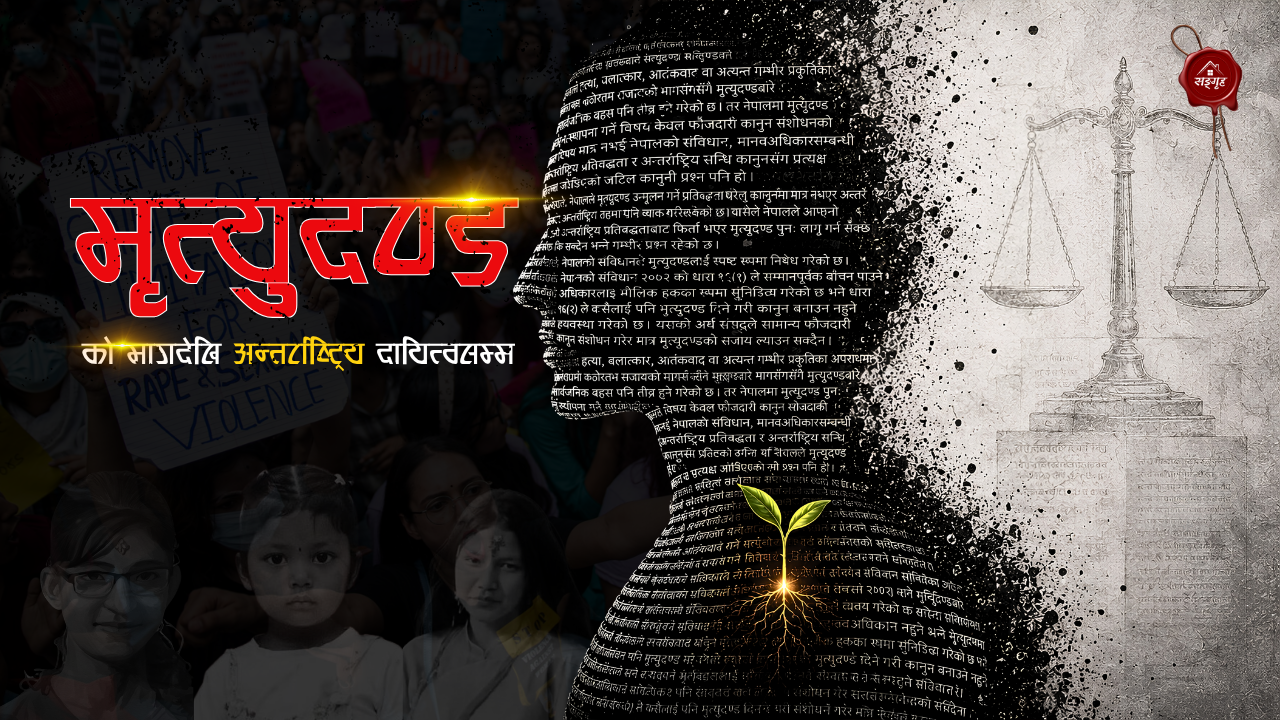
Nepal has once again been left in shock by an extremely painful incident. According to the preliminary police investigation, a three-year-old girl was allegedly raped and killed in the Jitpursimara area of Bara, an event that has deeply shaken the conscience of Nepali society. In the aftermath, protests demanding justice for the victim’s family have taken place, and calls for the death penalty for the culprit have echoed from the streets to Parliament. Demands for justice have also arisen in Kathmandu and various other places. Even in a session of the House of Representatives, lawmakers have called for the harshest punishment, including the death penalty, for those guilty of rape.
Alongside demands for the harshest punishment in crimes such as murder, rape, terrorism, or offences of an extremely serious nature, public debate over the death penalty has intensified in recent times. However, reinstating the death penalty in Nepal is not merely a matter of amending criminal law. It is also a complex legal question directly connected to Nepal’s Constitution, its international commitments on human rights, and international treaty law.
Because Nepal has expressed its commitment to abolishing the death penalty not only in domestic law but also at the international level, a serious question arises: can Nepal step back from its international commitments and reinstate the death penalty, or not?
Nepal’s Constitutional Commitment
The Constitution of Nepal clearly prohibits the death penalty. Article 16(2) of the Constitution of Nepal, 2072 (2015) guarantees the right to live with dignity as a fundamental right and provides that no law may be made to impose the death penalty on anyone. This means Parliament cannot introduce capital punishment merely by amending ordinary criminal law.

For example, if Parliament were to add a provision to the criminal law stating that “heinous murder shall carry the death penalty,” it would directly conflict with Article 16(2) of the Constitution.
Therefore, if the death penalty is to be introduced, the question of constitutional amendment arises at the very first stage. The provisions relating to constitutional amendment are found in Article 274 of the Constitution. But the mere existence of a power to amend the Constitution does not automatically make every change valid, particularly where it concerns the protection of fundamental rights and the basic values of the Constitution. Although Article 274 provides a process for amending the Constitution, whether Article 16(2) itself, which prohibits the death penalty, can be amended is a separate matter of constitutional interpretation.
Nepal’s Other Commitment at the International Level
Nepal is a State party to the International Covenant on Civil and Political Rights (ICCPR). Similarly, on 4 March 1998 Nepal acceded to the Second Optional Protocol to the International Covenant on Civil and Political Rights, aiming at the abolition of the death penalty, and thereby accepted its obligations. This creates a legal obligation upon States parties. Article 1 of the Protocol commits States parties not to execute anyone within their jurisdiction and to take all necessary measures to abolish the death penalty entirely.
This means Nepal has not merely said, “we are not using the death penalty for now.” Nepal has also accepted an international commitment to abolish the death penalty.
Can Nepal Withdraw from the Second Optional Protocol?
Generally, on the question of exiting an international treaty, the Vienna Convention on the Law of Treaties, 1969, is important. If a treaty contains an express provision for withdrawal or denunciation, a contracting State can exit that treaty by completing the process accordingly. However, the Second Optional Protocol contains no express provision for withdrawal or denunciation.
Under Article 56 of the Vienna Convention, if a treaty contains no express provision for its denunciation or withdrawal, a State generally cannot unilaterally denounce it. Only in exceptional circumstances, where it is established that the States parties intended to admit the possibility of denunciation or withdrawal, or where a right of denunciation or withdrawal may be implied by the nature of the treaty, may such a possibility exist.
The View of the Human Rights Committee
Another aspect that makes this matter even more serious is that the UN Human Rights Committee’s General Comment No. 36 expresses the view that a commitment to abolish the death penalty cannot be reversed. In particular, the Committee has taken the position that the Second Optional Protocol contains no provision for termination or withdrawal, and that a State party to it may not reinstate the death penalty.
From this, an important legal principle emerges. Once an international commitment to abolish the death penalty has been accepted, it cannot easily be reversed by an ordinary political decision.
Paragraph 6 of the UN Human Rights Committee’s General Comment No. 36 (2018) interprets in detail the right to life under the Covenant. It treats the right to life as the supreme and most fundamental right of a human being and places upon States parties the duty to respect, protect, and effectively implement the right to life. It links matters such as arbitrary deprivation of life, the death penalty, armed conflict, persons at risk, environmental risks, and a life of dignity to the right to life.
What Does International Practice Show?
There are many examples in the world of States exiting international commitments. But not all of them can be directly compared with the Second Optional Protocol.
The United States advanced the process of withdrawing from the Paris Agreement and formally withdrew in 2020, later rejoining. This clearly shows that a State can exit an international agreement that has a withdrawal clause by following the prescribed process.
Similarly, after the United Kingdom (UK) decided in the referendum of 23 June 2016 to leave the European Union (EU), it followed its own constitutional process and, on 29 March 2017, gave formal notice to the European Council under Article 50 of the Treaty on European Union (TEU). Negotiations for withdrawal then took place between the EU and the UK. The Article 50 deadline was also extended by mutual agreement, and ultimately, once agreement on the deal and the necessary ratifications were completed, the UK formally left the European Union on 31 January 2020.
However, the important feature of these examples is that the relevant legal frameworks contained a clear basis and process for withdrawal from the treaty. Therefore, these examples cannot be used as proof that Nepal can easily withdraw from the Second Optional Protocol.
Can Nepal Abandon the Second Optional Protocol Through a Unilateral Declaration?
Nepal cannot easily exit the Second Optional Protocol through a unilateral declaration alone. Were it to make such a declaration, a serious question would arise as to whether that declaration is valid under international law. The reasons are clear:
1. The Protocol contains no express provision for withdrawal.
2. Its core objective is the abolition of the death penalty.
3. The basis for separating from the treaty under Article 56 of the Vienna Convention appears very weak.
4. A change in domestic law alone does not terminate an international obligation.
Therefore, the basis on which Nepal could validly separate from the Second Optional Protocol through a unilateral declaration appears extremely weak. In particular, paragraph 34 of the UN Human Rights Committee’s General Comment No. 36 expresses the view that withdrawing from such a Protocol and stepping back is not possible, and that the abolition of the death penalty is legally irreversible.
If Nepal were to do so, it could give rise to a constitutional challenge domestically, while internationally the question could arise that Nepal has violated its obligations under the Second Optional Protocol.
Even if a violation of international law would not automatically create a situation in which the United Nations enters Nepal to repeal the death penalty law or to arrest government officials, it could seriously affect Nepal’s international human rights image and its international standing.
Possible Legal Paths for Nepal
The question of reinstating the death penalty can be viewed through four possible avenues.
First, ordinary legal amendment.
This path does not appear possible because of Article 16(2) of the Constitution.
Second, constitutional amendment.
In principle, the question of using the constitutional amendment process may arise. But this does not automatically terminate the international obligation.
Third, withdrawal from the Second Optional Protocol.
The greatest problem here is the absence of any express provision for withdrawal from the Protocol. As such, its basis in international law could be highly contested and weak.
Fourth, applying the death penalty in violation of international commitments.
This step could place Nepal in a position of violating its international treaty obligations. By contrast, measures such as life imprisonment, rigorous imprisonment, effective justice for victims, improved investigative capacity, strengthened evidence collection, and ending impunity can be developed as an alternative, robust criminal justice system without the death penalty.
If Nepal seeks to institute the death penalty, the first obstacle will be Article 16(2) of the Constitution. Even if the route of constitutional amendment is pursued, it does not automatically terminate Nepal’s international obligation under the Second Optional Protocol. The Second Optional Protocol also contains no express provision for withdrawal, and paragraphs of the Human Rights Committee’s General Comment No. 36 treat the abolition of the death penalty as legally irreversible. Therefore, in the current state of Nepal’s legal and international obligations, reinstating the death penalty would become an extremely serious constitutional and international legal question.
(The author is a student of law.)