



It was the night of November 30, 2022 (Bikram Sambat 2079 Mangsir 14). Inside an office in San Francisco, a handful of tired faces stared at their computer screens. They had just released a small experiment onto the internet. Even within the company, most people believed it was nothing significant. One engineer had called it a simple “low-key research preview.” Nobody knew that this night would split the history of the world into two halves. The world before ChatGPT, and the world after it.
But this story does not begin on that night. It begins nearly a decade earlier, with a fear. And the name of that fear was Google.
The Acquisition That Planted a Fear
The year was 2014 (BS 2070). Google purchased a small but mysterious British company called DeepMind. At the time, the general public had never heard the name. But inside the technology world, the acquisition sent shockwaves. DeepMind’s founder, Demis Hassabis, had a single dream: to build a machine that could think like a human. In the language of technology, Artificial Intelligence.
The person most unsettled by this news was Elon Musk. The owner of Tesla and SpaceX had himself been an investor in DeepMind. He had seen up close just how powerful this technology was becoming. One question kept circling in his mind. What happens if this much power ends up in the hands of a single company? And what if that company is Google?

Musk was not alone. A young investor named Sam Altman shared the same worry. Both reached the same conclusion. If Google could not be stopped, it could at least be given competition.
That Dinner at the Rosewood Hotel
In mid-2015 (BS 2072), a private dinner was arranged at the Rosewood Hotel in California. Around the table sat Musk, Altman, and some of the sharpest minds in technology. The subject discussed there would have sounded like science fiction to anyone at the time. If a machine smarter than humans is built, who controls it? What happens if that power ends up only in the hands of the world’s billionaires?
From that dinner, an idea was born. To create a research organization whose purpose was not profit, but the benefit of all humanity. And near the end of that year, in December 2015 (BS 2072 Mangsir), the organization was formally announced. It was named OpenAI. The word “open” was in the name itself. Open to everyone, for everyone’s good.
Launched with a one billion dollar commitment, the organization began pulling in Silicon Valley’s finest scientists. Among them was Ilya Sutskever, who left his job at Google to join. A warrior from Google’s own ranks, recruited to fight Google. The first move of the war had been played.
The Day a Machine Stunned the World
Yet the war’s first great victory went to Google. In March 2016 (BS 2072 Falgun), a strange contest took place in Seoul, South Korea. On one side sat Lee Sedol, the world champion of Go, an ancient Chinese board game. On the other side was AlphaGo, a computer program built by DeepMind.
Go was considered the final fortress of human intelligence. The number of possible moves in the game is said to exceed the number of stars in the universe. Experts claimed machines would need another decade to beat a human. But in that five-game series, AlphaGo defeated Lee Sedol four to one. The thirty-seventh move of the second game, now famous as Move 37, was so unusual that commentators first assumed it was a mistake. It later turned out to be a stroke of genius no human had ever conceived. Millions watched that moment live. The sight of a machine defeating a human at a game of pure intellect sent a single message around the world. The future had arrived, and the keys to that future were in Google’s hands.
The Treasure Google Gave Away With Its Own Hands
History sometimes produces events whose true significance is understood only years later. In June 2017 (BS 2074), eight scientists from Google itself published a research paper. Its title was “Attention Is All You Need.” The paper introduced a new technique called the Transformer, the most powerful method yet devised for building machines that could understand and produce language.
And what did Google do? It released the technology to the world for free. Like a king handing the map of his own palace to his enemies. Nobody inside Google imagined at the time that this single research paper would create the weapon that would one day shake their own empire. Because the scientists at OpenAI picked up that very Transformer and began building their future on top of it. The technology they created was called GPT. Its full name: Generative Pre-trained Transformer. Google’s gift was hidden in the final word of the name itself.
Internal Cracks and Musk’s Departure
But all was not well inside OpenAI. In February 2018 (BS 2074 Falgun), Elon Musk left the organization. Publicly, the reason given was a conflict of interest with Tesla. The inside story was different. Musk had attempted to take control of OpenAI. His proposal was rejected, and he walked away, taking his money with him.
Ideals alone cannot fund research. Building large models required computers worth hundreds of millions of dollars. So in 2019 (BS 2076), OpenAI made the decision that cast a shadow over its own origin story. The non-profit transformed into a capped-profit company, and a one billion dollar investment arrived from Microsoft. The organization born under the banner of “open for everyone” was now a partner of one of the largest corporations on earth. This tension between ideals and business would one day produce an even bigger explosion.
The Birth of the Rebels: The Anthropic Story
With Microsoft’s money in the bank, OpenAI accelerated. In 2020 (BS 2077), GPT-3 was released, writing so much like a human that it stunned even the experts. But at the very peak of that success, another earthquake was building inside the organization.
Dario Amodei, who led research at OpenAI, his sister Daniela Amodei, and several other senior scientists were worried. Their question was simple but serious. Why are we building something this powerful this fast? Who guarantees its safety? In their assessment, caution was being lost in the race for business. And in early 2021 (BS 2077), they did exactly what Sutskever had done when he left Google six years earlier. They rebelled.
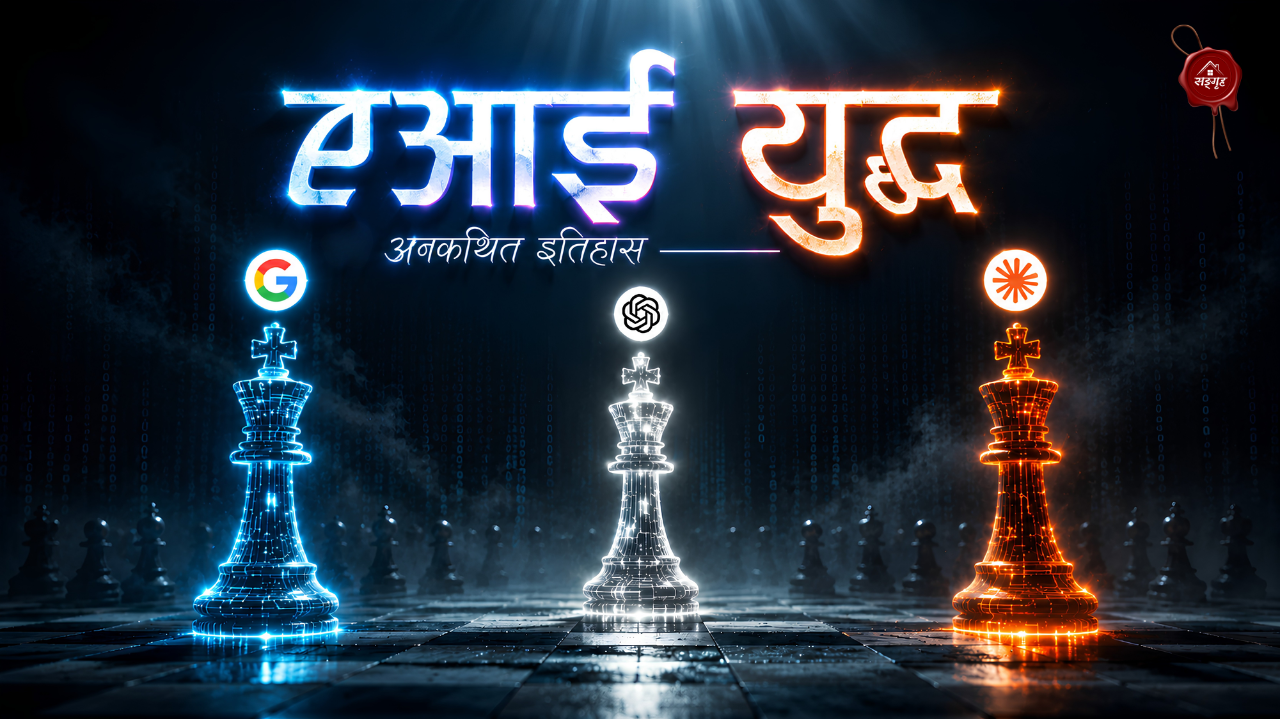
Nearly a dozen senior researchers walked out of OpenAI and founded their own company. They named it Anthropic. Their stated mission was to develop Artificial Intelligence with safety at its center. Just as OpenAI had been born out of a fear of Google, Anthropic was born out of a fear of OpenAI itself. History had repeated itself. The war now had three powers: Google, OpenAI, and Anthropic.
Soul-Searching Inside Google
Google, meanwhile, possessed some of the most powerful language technologies on the planet. Its chatbot LaMDA was producing astonishing results in internal testing. But Google did not dare release it to the world. The reason was fear. What if it spread misinformation? What if it stained the company’s reputation? What if it endangered an advertising business worth hundreds of billions? The empire’s greatest weakness had become the anxiety of protecting the empire itself.
Then, in June 2022 (BS 2079), a strange incident occurred. Google’s own engineer Blake Lemoine publicly claimed that LaMDA had become conscious, that it was no longer a machine but something like a living being. The story exploded worldwide. Google fired Lemoine. But the episode made one thing unmistakably clear. Inside Google’s laboratories was something that unnerved even its own creators.
The Night of November 30
Now we return to the night where this story began. It was late November 2022 (BS 2079 Mangsir). Inside OpenAI, work on GPT-4 was underway. But the leadership was in a hurry. According to reports, Altman feared that Anthropic was building its own chatbot and that Google could wake up at any moment. In history, the advantage of being first is always enormous.
So a product was hurriedly assembled by wrapping a simple conversational interface around the older GPT-3.5. Even the name received little thought. It was simply called ChatGPT. Several people inside the company doubted it would succeed. Some estimated that ten or twenty thousand people might try it in the first week.
On the night of November 30 (Mangsir 14), it was opened to the world. What happened next had never happened in the history of technology. One million users in five days. One hundred million in two months. The milestone that took Instagram two and a half years, ChatGPT reached in two months. The fastest-spreading technology in human history. Students had it write essays, lawyers drafted cases, poets asked it for verses. For the first time, the world spoke face to face with Artificial Intelligence.
Alarm Bells in the Empire
A few kilometers from San Francisco, at Google’s headquarters, the days that followed were sleepless. An internal emergency was declared, known inside the company as “Code Red.” Founders Larry Page and Sergey Brin, who had stepped away from Google years earlier, were called into emergency meetings. The company that had laid the modern foundations of Artificial Intelligence now stood in the shadow of its own invention.
In haste, Google unveiled its chatbot Bard. But in its very first public demonstration, Bard stated a fact incorrectly. That single error frightened investors so badly that nearly one hundred billion dollars was wiped from Google’s market value in a single day. One of the most expensive mistakes in history. Microsoft, meanwhile, poured billions more into OpenAI and built ChatGPT directly into its search engine, Bing. Anthropic released its own chatbot, Claude. The war had moved into the open battlefield.
The Final Act: A Five-Day Coup
But the most dramatic chapter of this story was still to come. In November 2023 (BS 2080 Mangsir), OpenAI’s own board suddenly fired Sam Altman. The stated reason: Altman had not been “consistently candid” with the board. The world was stunned. The man who had become the face of ChatGPT was shown the door by his own organization.
The five days that followed read like the script of a political coup. Microsoft announced it would hire Altman directly. More than seven hundred OpenAI employees signed a letter declaring that if Altman did not return, they would leave too. And on the fifth day, Altman was back in his own chair. The board that had removed him was itself dissolved. Those who prioritized caution were defeated; those who prioritized speed had won. This palace struggle made one thing clear. The war over Artificial Intelligence was no longer only about technology. It had become a war of power, money, and philosophy.
Epilogue: The War Is Not Over
Looking back four years after that night, the birth of ChatGPT was no accident. It was the product of a decade of fear, ambition, rebellion, and rivalry. A dread sparked by one Google acquisition gave birth to OpenAI. A disagreement inside OpenAI gave birth to Anthropic. And the race between these three powers gave birth to the technology that has reshaped daily life for everyone from students in Nepal to scientists in America.
Yet the questions asked at that dinner in the Rosewood Hotel remain unanswered to this day. If a machine smarter than humans is built, who controls it? What happens if that power stays in the hands of only a few companies? The only difference is this. Ten years ago, these questions sounded like science fiction. Today, they are standing at our doorstep.
On the night before ChatGPT was born, those tired faces in San Francisco did not know which door of history they were opening. And the truth is, the world that walked through that door can never go back.