
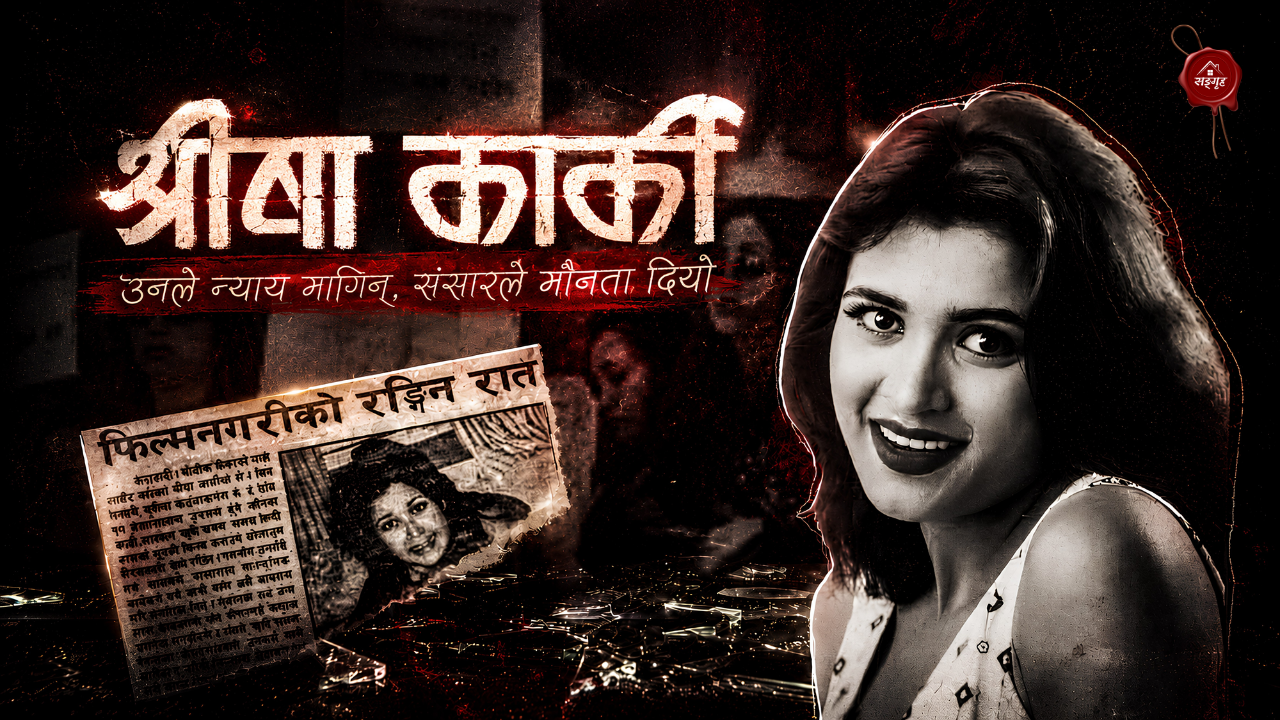
Autumn 2002 (Asoj 2059 BS).
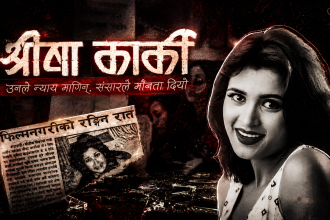
Inside a house in Bhaisepati, Kathmandu, 24-year-old actress Shrisha Karki was found dead.
Within hours, the news had spread across all of Nepal. The film industry was stunned. Anger spilled into the streets. Newspapers were burned. Journalists were attacked. And one question struck the conscience of an entire country:
“Can a newspaper take someone’s life?”

More than two decades later, that question is still alive. Because the death of Shrisha Karki was not merely the suicide of an actress. It was a living document of the moral collapse of Nepali journalism, the exploitation inside the film industry, violence against women artists, the protection of powerful networks, and the failure of the justice system.
A Rising Dream That Nepal Failed to Protect
Shrisha Karki was a newly rising actress in the Nepali film industry. Her presence was magnetic, her acting natural, and her face carried a quiet, distinctive confidence.
She entered cinema in 1997 (2054 BS) with “Yo Maya Le Laun Satayo,” and established herself within a remarkably short time. Films like “Aafno Birano,” “Gham Chhaya,” “Jamin,” “Saltini,” and “Maya Baiguni” had already brought her into the spotlight.
But behind the face that shone on screen, a harsh struggle was hidden.
The Nepali film industry of that era was nothing like today’s. Actresses were treated less as “artists” and more as “objects.” Among producers, journalists, middlemen, photographers, and the politically connected, women artists were chronically unsafe.
Shrisha became a victim of that very structure.
The Photograph: Not a Picture, but a Planned Trap
At the center of the case was a photograph.
When the weekly tabloid “Jana Aastha” published a nude photograph of Shrisha, the entire country convulsed. Alongside the image, she was portrayed as an “actress involved in prostitution.”
The reality was far more horrifying.
According to multiple investigative reports, the photograph was not taken with her consent. Shrisha was called to an apartment. There, a group of men used pressure, threats, and conspiracy to strip and photograph her.
The name of former police officer Uddhav Bhandari became attached to the incident, along with a photographer and several individuals connected to the film industry.
The objective was never just a photograph.
The objective was: blackmail. Control. Exploitation.
In Nepal at that time, “sex scandal” journalism was a thriving market. Newspapers sold by trading in women’s private lives. Character assassination was dressed up as “exposé journalism.”
Shrisha became its biggest victim.
“Jana Aastha” and the Dark World of Yellow Journalism
“Jana Aastha” was not merely a newspaper. It was a weekly power center of its time — politically connected, built on sensationalism, and in the habit of calling personal attacks “investigative journalism.”
When the paper’s editor, Kishor Shrestha, published Shrisha’s photograph, condemnation erupted across the country. But the question was never only about one printed image.
The questions were:
- How was a woman’s private photograph obtained?
- Why was its authenticity never verified?
- Why was the victim’s side never heard?
- Where was the ethics of journalism?
And the biggest question of all: is selling newspapers through the character assassination of a woman journalism at all?
For years, irresponsible practices had flourished in Nepal under the banner of press freedom. “Jana Aastha” became their most extreme form.
This was not just an attack on Shrisha. It was public violence against the dignity of all women.
Shrisha’s State of Mind: A Society That Left Her Alone
After the photograph was published, Shrisha’s life turned into a sudden hell.
The way people looked at her on the street changed. The phone calls began. Then the abuse. Then the public commentary on her character.
In a society like Nepal’s, once a “sexual allegation” attaches to a woman, society delivers its verdict before the truth ever arrives.
Shrisha tried to say she was innocent. But she had no power. The media had already declared her guilty.
According to those close to her, she was under severe psychological distress in those days. She was frightened. She felt humiliated. And most tragically of all — she was becoming more and more alone.
Nepal had no culture of talking about mental health. It was a society that told women artists to simply “endure.”
So while Shrisha was breaking apart inside, society watched it as a spectacle.
That Morning: When a Life Ended
On that morning in autumn 2002, Shrisha was found dead in her own home.
Her death shook the Nepali film industry to its core. Thousands of artists poured into the streets. The “Jana Aastha” office was attacked. Kishor Shrestha went into hiding.
Producer Ashok Sharma declared publicly:
“This is not a suicide. This is a planned murder.”
Shrisha’s mother held the journalists and the blackmail ring responsible.
And then what happened?
Nepal slowly forgot everything.
The Justice System: Where the Victim Dies and the Guilty Survive
A case was filed after Shrisha’s death. The Press Council acknowledged that “Jana Aastha” had violated the journalistic code of conduct. An apology was issued.
But justice?
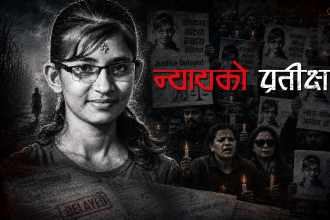
No one was ever punished.
Kishor Shrestha, Bishwamani Subedi, and Padam Raj Pandey ultimately walked free. The police investigation remained superficial. The central questions were never pursued in depth.
The accusation that people with powerful connections routinely escape Nepal’s justice system is not new. Shrisha’s case became its burning example.
The crowning irony came later:
Kishor Shrestha himself eventually rose to the leadership level of the Press Council Nepal.
The very man accused of murdering the ethics of journalism later reached the position responsible for regulating the ethics of journalism.
This is not merely irony. It is a symbol of Nepal’s institutional decay.
Uddhav Bhandari: A Figure Wrapped in Mystery
The other grave figure in this case was Uddhav Bhandari.
A former police officer. A security background connected to the royal palace. Then controversy. Then a move into journalism.
His name became tied to the photograph conspiracy. But he never openly told the truth.
He later reached the United Kingdom and sought asylum. He died in Glasgow, taking his own life in 2004.
His death gave birth to even more questions.
- Was he only a pawn?
- Was the network bigger than him?
- Was the truth buried to protect powerful people?
To this day, there is no clear answer.
The Dark Reality of the Nepali Film Industry
Shrisha’s death exposed a brutal truth inside Nepali cinema:
Women artists were not safe.
The casting couch, blackmail, sexual propositions, pressure disguised as career advice — these had existed inside the industry for years, but no one spoke openly.
Why?
Because any woman who spoke was branded “characterless.”
Shrisha’s death jolted the industry for a while. But did the structure change?
The honest answer: not much.
Even today, many women artists are fighting social media trolling, the fear of private photographs being leaked, and the pressure of powerful networks.
The Black Mirror of Nepali Journalism
The Shrisha Karki case exposed one enormous truth:
In Nepal, journalism has at times been not a means of seeking truth, but a weapon for exercising power.
When journalism sells character assassination instead of facts, when a woman’s private life is turned into “content,” when humiliation is labeled “investigative reporting” —
that is not journalism. That is organized violence.
The death of Shrisha Karki remains a permanent stain on the history of Nepali journalism.
The Final Question: What If Shrisha Were Alive Today?
Imagine:
What if that photograph had never been published? What if the police had acted in time? What if society had seen her as the victim, not the guilty party? What if journalism had not abandoned its ethics?
Perhaps today Shrisha would be one of the leading actresses of Nepali cinema.
But Nepal never gave her that chance.
Conclusion: Shrisha Is Not Just an Actress Who Died — She Is Nepal’s Collective Failure
The death of Shrisha Karki was not merely the end of one person. It was a declaration of our society’s failure.
We could not protect one young woman. We watched journalism sell her. We watched the justice system shield the guilty. We watched society blame the victim herself.
And the most frightening thing of all:
these structures are still alive today.
The only difference is this: social media has taken the place of “Jana Aastha.” Character assassination happens faster. Digital violence against women has become even more widespread.
Shrisha’s story is not history. It is a warning.
If society, journalism, the justice system, and the film industry do not change their soul, another Shrisha will be born tomorrow. And another life will quietly end.
That is why remembering Shrisha Karki is not just remembering an actress.
It is preserving memory against injustice. It is breaking the silence. And it is asking one question, again and again:
“In a country where truth dies, who, in the end, is guilty?”
This article deals with a sensitive subject. It is written with respect for Shrisha Karki, with the aim of demanding journalistic ethics, the safety of women, and justice. This is an English translation of our original Nepali report.
If you or someone you know is struggling emotionally or having thoughts of suicide, please reach out for support. In Nepal, you can contact the TUTH Suicide Hotline at 9840021600 or TPO Nepal’s crisis helpline at 1660-010-2005. You are not alone, and help is available.